


December 15th: A cannibal feast all the way to the South Pole
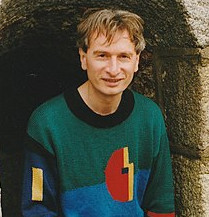

Rudolf von Laban in 1913, invited to Ascona to create a summer school uniting the Monte Verità community through dance.
On this Universal Esperanto Day, the day's almanac is entrusted to the poet Patrick Beurard-Valdoye, who takes us on a journey from Beethoven to Kurt Schwitters, by way of Rudolf von Laban, Oscar Niemeyer, Ray Eames, the Mona Lisa, Antonin Artaud, Meret Oppenheim, and Romain Rolland's appeal, " To all peoples, come to the aid of the victims of Spain ." Finally, without losing our bearings, we reach the South Pole with Roald Amundsen. A veritable feast. Cannibalistic, needless to say.
17 days to go: Tax-deductible donations until 31/12/2025
Countdown: We have 17 days left to raise between €3,500 and €4,000 by December 31st. This will allow us to improve the website and its SEO, and to hire our first journalist—conditions required to (finally!) hope for possible public funding in 2026. We're getting closer: since the launch of this campaign (October 31st), we have received 39 donations and have raised €2,605.
As a reminder, we have chosen a completely free, ad-free website that relies solely on the support of our readers. Until December 31, 2025, donations are tax-deductible (up to 66% of the donation amount). A €25 donation thus only costs you €8.50 (€17 for a €50 donation, €34 for a €100 donation, €85 for a €250 donation). Donations or subscriptions HERE
EPHEMERID
December 15th is Universal Esperanto Day , as its inventor, Louis Zamenhof, was born on this day in 1859 in Northeast Poland. He spoke three languages in a multilingual area.
On that same day in 1770, Ludwig van Beethoven was born in Bonn. Or perhaps on December 16th (the date more commonly accepted). In the Habsburg Empire, he was tolerated for his "eccentricities." The brilliant composer believed that courtiers should step aside when he passed, rather than the other way around. This disconcerted Goethe during their walk, when a princess passed by. Unlike Goethe, Beethoven walked straight ahead. As a result, they never saw each other again.
Beethoven had dedicated the funeral march of the Third Symphony to the revolutionary Bonaparte, but following the dictator's coup, he crossed out the dedication. Opus 111 – his last piano sonata, completed in 1822 – already represents a post-Romantic work.
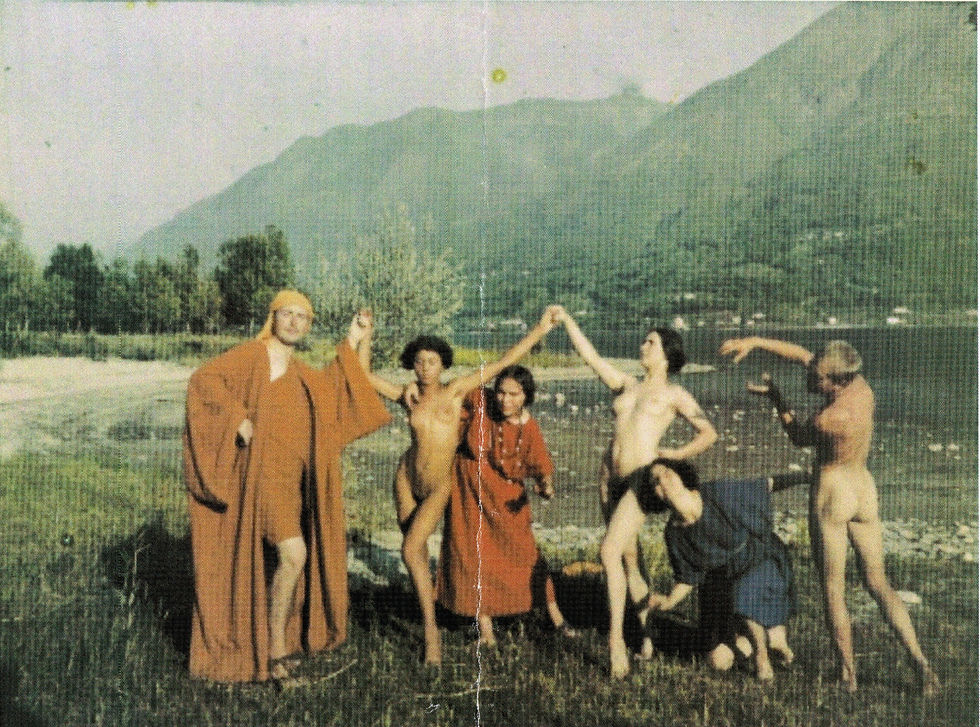
On December 15, 1879, the dancer and choreographer Rudolf (von) Laban was born in Bratislava (then in the Austro-Hungarian Empire). He was a pioneer of modern dance, and more specifically of expressive dance, and the inventor of a notation system for modern dance movements, called Labanotation.
Impressed in his youth by the folk group dances of Hungary and Bosnia, he focused on the art of movement from a modernist perspective, founding his school in Munich in 1910. In 1913, he was invited to Ascona to create a summer school uniting the Monte Verità community through dance. Among those who joined him were Suzanne Perrottet, Marie Wigman, and Sophie Taeuber.
In the 1920s, he became a leading figure in modern dance, founding a theater in Hamburg, then an institute in Berlin, before directing the Berlin Opera Ballet. His stance during the rise of Nazism and his collaboration with the Nazis were hotly debated, culminating in the Berlin Olympics where, during a dress rehearsal, Goebbels disavowed him and placed him under house arrest. During these years, a key issue was the emancipation of the body through expressive collective dance (Laban), or the subjugation of the body through directive dance-based gymnastics.
Laban sought refuge in England. During the war, he provided kinesthetic therapy to female workers in munitions factories. In 1946, he founded the Art of Movement studio in Manchester.
Suzanne Perrottet was still running her dance school in Zurich at the age of 90. Something momentous happened when she died in 1983. Under her bed was a large suitcase, which she had never mentioned. Harald Szeemann, who had been instrumental in rediscovering and archived Monte Verità, was summoned. The suitcase contained Rudolf Laban's personal papers, a piece of avant-garde history. Programs, photographs, and correspondence revealed the forgotten connections between expressive dance and the visual arts, the language arts and music; the dance school as much as the Cabaret Voltaire or the Dada gallery. Fleeing Berlin in 1936, Laban entrusted the suitcase to Suzanne Perrottet, who kept it for almost fifty years. With it, the history of the Zurich/Monte Verità Dada constellation could be traced.
In 1907, Oscar Niemeyer was born in Rio de Janeiro. The architect championed the elegance of the curve, in contrast to the modernist orthodoxy devoted to orthogonal spaces. "While the right angle separates and divides, I have always loved curves, which are the very essence of the surrounding nature." Le Corbusier himself challenged the obligatory perpendicular lines with his chapel at Ronchamp.
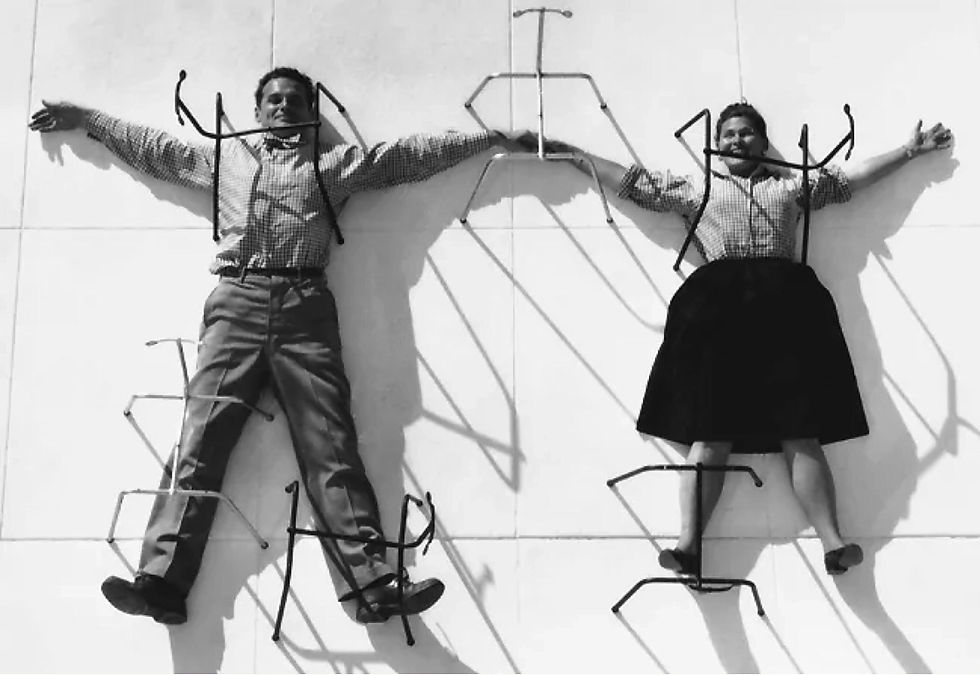
Charles Ormond Eames (1907-1978) and Bernice Alexandra "Ray" Kaiser Eames (1912-1988) were two of the designers
the most important and influential figures in post-war America. They created some of the most famous pieces of furniture
from the 20th century, such as the Eames Lounge Chair, the Eames Dining Chair, and the Eames Aluminum Group series
(office chairs and conference chairs). Their designs are as popular today as they were in the last century.
On December 15, 1912, Bernice A. Kaiser, known as Ray Eames , was born in Sacramento . She is one of the leading figures in 20th-century design , alongside her husband, the architect Charles, and co-founder of what would become the "Eames Office" in the 1940s. Prior to this, Ray pursued abstract painting, studying in New York with the German-born painter Hans Hofmann (who had a considerable influence on American Expressionism). The Eameses are world-renowned for their furniture, but the scope of their creative work was broad, encompassing architecture. Ray Eames died exactly ten years after her husband, in 1988. She devoted her final years to building a significant archive of the firm and the modernist era.
In 1913, the stolen Mona Lisa was finally recovered. It had disappeared in 1911. Because poets were viewed with suspicion, Apollinaire was imprisoned for six days. Picasso—a foreigner painting impossible pictures—was also implicated. But the culprit (of the crime) was the Italian glazier Peruggia. No need for a hoist. Dressed in his work clothes, he allowed himself to be locked in, hiding the painted wood under his smock. He left the museum without being apprehended.
On December 15, 1936, Romain Rolland's appeal , "To all peoples to the aid of the victims of Spain, " appeared in the journal Europe : "A cry of horror rises from the smoking stones of Madrid. The proud city that was once queen of half of the Old World and the New – that which was one of the radiant centers of Western civilization – is being put to fire and blood by an army […] whose factious leaders dare to claim to be acting in the name of the Spain they are ravaging and the civilization they are trampling underfoot."
It should also be noted that on December 15, 1976, the Law for Political Reform in Spain was submitted to a referendum. 94% of voters approved the text, including Francoist parliamentarians. The law paved the way for a constitutional monarchy.
On December 15, 1947, Antonin Artaud's book, * Van Gogh, the Man Suicided by Society * , was published by K. Éditeur. Artaud had visited the exhibition at the Musée de l'Orangerie on February 2nd, at a brisk pace. He didn't mince words: "Faced with the lucidity of Van Gogh at work, psychiatry is nothing more than a den of gorillas." The text defies conventional categorization. It is neither essay, nor narrative, nor art history text. It represents a new way of writing with art, its form akin to poetry. An excerpt: "I think Gauguin believed that the artist must seek the symbol, the myth, magnify the things of life to the point of myth, / whereas Van Gogh believed that one must know how to deduce myth from the most mundane aspects of life. / In which I think he was damn right."

On December 15, 1959, at the opening of the Eros exhibition proposed by André Breton, The Cannibal Feast, by Meret Oppenheim.
Photo by William Klein.
That evening in 1959, at the Daniel Cordier gallery in Paris, the opening of the Eros exhibition , curated by André Breton, took place. Visitors saw—or caught glimpses of— Meret Oppenheim's performance (already staged in Bern), The Cannibal Feast. On the body of a naked woman whose face was gilded, she had placed food from the buffet, including vegetables and lobster. For so long, Meret Oppenheim has been presented as a muse or an icon of Surrealism. She was, quite simply, a great artist.
Concerned about his daughter's erratic behavior, the Swiss physician Oppenheim asked his colleague Carl G. Jung for a consultation. Jung replied: "I have seen your daughter and I don't believe her case is too serious… I don't get the impression that it involves any neurotic complications. Her artistic temperament and the fact that young people today aspire to go against the all-powerful rationality of the 19th century are sufficient explanations for unconventional ideas…"

Undated photograph of explorer Roald Amundsen. Possible date: 1912 or earlier. Wikimedia Commons/Public domain
In retrospect, and to conclude with the chill of winter approaching: on December 15, 1911, the Norwegian Roald Amundsen reached the South Pole . Or the 14th, as both dates are considered correct. Arriving in the Bay of Whales aboard the ship "Fram," he established his base camp at Framheim , from where he set off towards his destination on skis and with a team of sled dogs.
It was a great success, overshadowed however by the fact that his competitor Scott and his teammates had tragically disappeared.
Learning shortly before his departure for the North Pole that two competitors had just succeeded, Amundsen changed his plans and decided to secretly set off for the South Pole, without even informing the crew.
He was able to carry out his expedition thanks to the "Fram", Fridtjof Nansen's ship.
Without wishing to overshadow Amundsen's superb achievement, allow me to emphasize Nansen's contribution, which would have immense humanitarian repercussions. Almost two decades earlier, he had become convinced that the ice pack was moving. This was considered impossible and delusional. To prove it, he had a vessel built for an absurd project: the boat would become trapped in the Arctic ice. It would then be "enough" to let it drift to observe the changes in latitude.
The audacious explorer thus invented an improbable method of discovery, while remaining completely still. No one had ever seen a boat like it, with its rounded hull and keel, and its massive, wide appearance. Marine scientists and technicians believed the boat would be crushed by the ice anyway.
Stubborn as ever, Nansen meticulously prepared for the adventure. After six months, the Fram had held firm, but the results were far from conclusive. It was then that he decided on an expedition with only one companion, using a dog sled and kayaks. In hellish conditions—described in his book * To the Pole *—they managed to reach land at a latitude considered inaccessible. The entire journey lasted two years. Meanwhile, everyone believed Nansen and his crew to be dead, including his wife—the opera singer Eva Sars—a heroine, for having had to endure such a "bear" on a daily basis.
The success of this audacious undertaking was immense, and its impact worldwide. Legend had it that when Nansen entered a room, a cold wind would be felt behind him.
In 1920, the International Committee of the Red Cross and the fledgling League of Nations were grappling with a problem involving approximately one million prisoners of war who had still not been released (primarily in the USSR and Germany) and were being held in appalling conditions. Without a solution—without the slightest lead—and not even knowing the number of prisoners, a team visited Nansen in Lysaker (near Oslo). “Can you help us repatriate all these prisoners?”
He went to the Queen of England to recover confiscated German ships. He met individually with the political leaders of the countries concerned, including Stalin, who complied. Nansen resolved the humanitarian crisis in a few months. A new problem arose with the dismantled Ottoman Empire. How could stateless Greeks living in Turkey be allowed to return to Greece? And conversely, how could Turks living in Greece be allowed to return? He invented the Nansen passport (an identity and travel certificate that he then had recognized by fifty countries), authorizing a transit visa in the countries through which it passed.
There were also Armenian refugees; then exiles from the USSR. This passport, used until 1945, concerned millions of refugees. It is therefore no surprise that Fridtjof Nansen was the first High Commissioner for Refugees. He received the Nobel Peace Prize in 1922. Faced with so much misery after the conflicts, he declared: "The most horrible thing about war is the aftermath . "
The exiled artist Kurt Schwitters – who lived 1 km from Nansen's house – narrowly escaped invaded Norway in June 1940 on the military ship "Fridtjof Nansen" (see Le Narrated from the Schwitters Islands , Al Dante editions).
There are very few Nansen streets or avenues in France. The one in Yutz in Moselle was called Rue Rudolf Hess during the Nazi occupation.
Patrick Beurard-Valdoye
Patrick Beurard-Valdoye is a French poet, performer, and essayist associated with a poetry of "crossed Europe" that blends history, geography, oblique biographies, and the memory of 20th-century violence. He is particularly known for his vast poetic cycle entitled "The Cycle of Exiles," a series of book-poems published primarily by Flammarion, in which each volume explores a territory, a history, or a displaced community (political exiles, border crossings, minorities). This cycle articulates archives, anonymous voices, historical figures, and fragmentary autobiography, blurring the lines between poetry, narrative, and documentary inquiry.
Comments