


Putin's secret plan to win the French presidential election


Participants in the "SputnikPro / AI" session from June 21 to 27, 2026 in Moscow.
A participant in the June 2026 session of the "SputnikPro AI in Media" program—a training course for foreign journalists organized in Moscow by the state-owned holding company Rossiya Segodnya—testifies that, upon completion of the course, he was offered €8,000 per month to "collaborate" with Russian intelligence services. This previously undisclosed detail, obtained by our editorial team, sheds new light on a program officially presented as a simple cultural exchange between young media professionals, but deployed from Ghana to India via Jordan—and which completes a broader picture: deepfakes targeting French political figures, the Pravda propaganda network, a Russian ministry dedicated to AI disinformation, and a political channel maintained in Paris. Our investigation reconstructs, piece by piece, the strategy that the Kremlin is deploying eight months before the 2027 French presidential election.
Exclusive investigations, columns, analyses, stories, "off-the-beaten-path" features: to stay informed:
It's no secret: Putin is furious. Furious with Emmanuel Macron, with France, with us. The presence of Ukrainian soldiers on the Champs-Élysées during the Bastille Day parade was the last straw for the Kremlin, where Putin vents his spleen daily. And right now, his spleen is boiling over. Because it's not just France.
After Hungary, where despite considerable resources Moscow failed to keep Viktor Orbán in power [1] , and after the fiasco in Armenia, where London sanctioned forty-nine additional employees of the Social Design Agency on May 11, 2026, as well as a dedicated structure, ANO Strategic Communications Caspian 2030, specifically accused of attempting to influence the June 2026 parliamentary elections [2] , the French presidential election is the next target. Judging by the modus operandi already observed elsewhere, Kremlin strategists have a ready-made strategy.
Unsurprisingly, there should be, about ten days before the first round of the election, an "Islamist" attack on French soil—probably not in Paris, which is too heavily guarded. The masterminds behind this impending false-flag crime [3] may already be in place. Not at the Russian Federation embassy, that would be too conspicuous, but still in the very heart of Paris, a stone's throw from the Eiffel Tower: at the Holy Trinity, aka "Putin's Cathedral," or even "Kremlin-on-the-Seine." Are the ways of the Lord not inscrutable?

The domes of the Russian Orthodox cathedral on the grounds of the Russian Spiritual and Cultural Centre, Quai Branly in Paris.
Photo by Dominique Boutin / TASS
Under the dome of Kremlin-on-the-Seine
The Russian Orthodox Spiritual and Cultural Center, inaugurated on the Quai Branly on October 19, 2016, by Paris Mayor Anne Hidalgo, was conceived as early as 2007 by Vladimir Putin himself. Its dome reaches a height of 37 meters—the maximum permitted by Parisian urban planning regulations. Since April 2023, our investigation [4] has documented serious suspicions about its activities, beyond religious worship and a “literary salon” sponsored by a foundation that is nonetheless under European sanctions. But this investigation, which has not been picked up by any other media outlet, has been to no avail. While the Ministry of the Interior signed an expulsion order on July 29, 2026, against Xenia Fedorova, former head of RT France who became a star columnist for the Bolloré group's media outlets—and, in reality, rather insignificant—Emmanuel Macron is not inclined to dislodge the nest of spies who are plotting on the Quai Branly while pretending to pray.
The summer of stink bombs
The planned "Islamist" attack will, so to speak, be merely the icing on the cake. Meanwhile, "interference" is already on the rise. Raphaël Glucksmann was targeted on August 4, 2026, in an operation attributed to the Storm-1516 network—"directly controlled by the GRU," according to information he claims to have received from the SGDSN (General Secretariat for Defence and National Security)—via a fake website replicating 181 pages of the Blast media outlet and a highly sophisticated voiceover imitating Edwy Plenel. On the same day, Gabriel Attal was targeted by fake news reports using the visual identities of RFI, BFM-TV, France 24, and Le Monde , portraying him as suffering from Parkinson's disease—an operation that VIGINUM attributes to the Matriochka network "with a high degree of confidence." Ten days earlier, on July 24, it was Édouard Philippe's turn to be targeted by fake news claiming he was suffering from senile dementia. These smear campaigns generated more media hype than they actually snowballed on social media—fewer than 30,000 views on X for the attack against Raphaël Glucksmann—but social media remains the Trojan horse for future attacks.
Test mode, smokescreen
A flop, then? Not really. For now, the Kremlin is still in "testing" mode. And if the content of these "interferences" is rather poorly executed, it's undoubtedly intentional. This isn't yet the "special operation" of hybrid warfare, just the beginnings—beginnings that also serve as a smokescreen. While state intelligence services are struggling to decipher the origin of these crude attacks, they risk being less aware of what's being prepared elsewhere, and in what form.
Diversion is an old Russian and Soviet military doctrine: maskirovka , the art of making the adversary look where nothing essential is happening. Le Monde confirms this in another way: the crude deepfakes targeting Édouard Philippe, Gabriel Attal, and Raphaël Glucksmann have, to date, had virtually no measurable impact on public opinion—but their public denunciation by the candidates themselves serves the interests of the agencies that create them, which can then use them to demand more funding from their sponsors. The real risk, documented since 2017, lies elsewhere: hacking followed by the leak of internal documents—"hack and leak." Making noise with the fake to better conceal the truth: this is, very precisely, the logic of diversion.
This mixing of genres is the very signature of the Russian influence apparatus targeting France: on the one hand, bungling, unassuming tactics—fake websites that fool no one, synthesized voices identifiable in seconds, messages written in English for a supposedly French audience; on the other, a formidably organized state infrastructure. The "Pravda" network of websites, mapped by VIGINUM as early as 2024 under the code name "Portal Kombat," published approximately 6,000 articles per day in 2024; it now publishes nearly 23,000, according to a study by the Institute for Strategic Dialogue reported by The Guardian [5] . The objective is no longer to convince a human reader, but to flood the web in order to contaminate the language patterns that millions of voters will question during the campaign. To date, this is the most sophisticated—and most underestimated—vector for 2027.
Budapest, dress rehearsal — a failure
Hungary remains the best-documented case. On March 21, 2026, the Washington Post revealed that a unit of Russia's foreign intelligence service (SVR), concerned about the collapse of support for Viktor Orbán, had considered staging an assassination attempt [6] . An analysis of more than 628,000 Telegram messages, published by Reuters on April 10, established that the six main sources amplifying pro-Orbán narratives were linked to Russia. On April 12, 2026, Orbán nevertheless lost: Péter Magyar's Tisza party won 141 out of 199 seats [7] . The Russian influence machine was mobilized at full capacity for a European national election. It did not prevent its candidate's defeat. This is the most useful warning for France: the mobilization of the apparatus is a verifiable fact; its electoral effectiveness is not.

Participants in the "SputnikPro / AI" session from June 21 to 27, 2026 in Moscow (screenshot)
Russia forced to train new battalions
So, how does Putin really plan to win the French presidential election? To win this new battle in the "hybrid warfare" waged by the Kremlin's tsar, he first needs to develop new skills. However, as with the army on the Ukrainian front, the Kremlin has recruitment problems. North Korean cannon fodder works for a while, but it's not sustainable in the long run. On the disinformation front, Russia certainly has its troll factories, far from inactive—as we saw earlier with the "Pravda" network—but they lack skilled workers. Generating code, imitating and reproducing the graphics of a media outlet like Blast , is no problem; these troll factories are efficient. But when it comes to editorial content, they lack brains.
Fortunately, the Kremlin has a countermeasure. The operation is called “SputnikPro AI in Media.” Officially, it is an “international training module,” organized by the state-owned holding company Rossiya Segodnya—parent company of the Sputnik news agency and RIA Novosti—in partnership with the federal agency Rossotrudnichestvo, responsible for Russian humanitarian and cultural cooperation abroad, as part of the “New Generation” (Novoe pokolenie) mobility program for young foreigners. Launched in 2011 by presidential decree, this program has already attracted more than 11,000 participants from over 150 countries to Moscow, with the stated objective, according to an investigation by the investigative media outlet iStories , of eventually creating a network of foreign leaders “constructively” disposed toward Russia [8] .

Participants at the "SputnikPro / AI" session from June 21 to 27, 2026 in Moscow. Photo: Vitali Beloussov / RIA Novosti
The last “SputnikPro” session took place from June 21 to 27, 2026 and brought together twenty-two young journalists and media professionals from eighteen countries — Serbia, Lebanon, Tunisia, Oman, Morocco, Indonesia, Malaysia, Senegal, Congo, Brazil, Vietnam, Kenya, Egypt, Nepal, Cambodia, Turkey, Ethiopia, Peru [9] —, some of whom were recruited from the Francophone area (Maghreb, sub-Saharan Africa) via Russian Houses and Russian cultural centers abroad, which have served as local relays for the “New Generation” program since 2011.
The program included: algorithmic monitoring and analysis of current events, AI-assisted audio and video production, translation and social media management tools, and sessions on the "ethical and legal challenges" of AI, presented, however, from the perspective of Russian institutions. The highlight of the stay was a meeting at the Russian Ministry of Foreign Affairs with Maria Zakharova, Director of the Information and Press Department [10] . "'New Generation' is a flagship international project for young people," said Kirill Bogomolov, Deputy Director of Rossotrudnichestvo, for whom this internship at Rossiya Segodnya was "the ideal place to observe how professionals use AI to solve concrete problems in the sector" [11] .
On the ground, those most directly involved are playing along with an enthusiasm that sometimes borders on promotional naiveté. Laith Alassaf, head of social media for the Jordanian daily Ad-Dustour , sees it as "a valuable professional opportunity to explore the latest advances in artificial intelligence and its growing application to journalism and the media ," praising "the international format of the program," which "creates a unique framework for sharing experiences and constructive exchanges on the main challenges facing the media worldwide" [12] . Agouram Abdelaaziz, a journalist with the Moroccan daily Hespress, echoes this sentiment [13] . “SputnikPro fully meets the growing needs of journalists in the age of artificial intelligence. Participants will be able to use the knowledge gained to improve the efficiency and performance of their journalistic work” [14] . From Vietnam, Nguyen Thuy Linh, from the state-owned VTV, expressed surprise at the way Russian media are integrating artificial intelligence into journalism, adding that “the humor of the speakers made the discussions more interactive and enjoyable” [15] . Another participant, identified in the caption of a promotional video released by Rossotrudnichestvo as the young Tunisian journalist Sana Sadouina, praised the training as “really very useful,” having given her “a much broader understanding of the new tools and skills” [16] —though no other evidence of journalistic activity under her name could be found online.
Interview with a Tunisian journalist presented as "Sana Sadouina", interviewed by the federal news agency Rossotrudnichestvo
June 23, 2026, broadcast on the Facebook page of the Russian House in Tunis.
This training is fully funded by the Russian federal budget: Rossiya Segodnya received 9.4 billion rubles in 2023, and is expected to receive 11.18 billion (about $135 million) in 2026 — an amount that is part of a general increase in funding allocated to Russian state propaganda, now exceeding 146 billion rubles ($1.78 billion) per year [17] .
But, as with some DVDs, there is a bonus that Rossotrudnichestvo makes no mention of in any press release. According to testimony gathered by our editorial staff from one of the participants in the June 2026 session—who requested anonymity due to the real risks to his safety and career—an unwritten agreement was allegedly offered to him at the end of the training: €8,000 per month to "collaborate" with the Russian intelligence services. This sum does not appear in any public budget line of Rossiya Segodnya or Rossotrudnichestvo; Our source attributes it to external funding, that of the fascist oligarch Konstantin Malofeev — historical financier of the Donbass separatists, but also of the European far right — including the National Front in 2014 — under European and American sanctions since 2014, indicted by the American justice system in 2022 for violating these same sanctions.
The Kremlin bullfight
As we will see later, the recruitment of "digital writers" does not stop there…
For the past few months, Ukrainian drones have been sowing discord in Russia and its Crimean annex. Despite being a poor matador, Putin has decided to seize the bull by the horns… Since the end of June 2026, SBU drone operators claim to have conducted over a hundred strikes against strategic Russian targets—defense industrial sites, airfields, command posts, ships, tankers, and refineries—targeting airfields in Crimea at Saky, Hvardiiske, Belbek, and Baherove [18] . Ryazan, Perm, Taganrog, Volgograd, Saratov, Bashkiria: in just a few weeks, some fifteen Russian refineries have been hit, causing fuel restrictions and long lines at gas stations as far away as Moscow [19] .
It was in this climate that Vladimir Putin convened the General Staff of the Ministry of Defense on August 5, 2026, to announce a sweeping reshuffle of the military command—a continuation of the restructuring initiated after the dismissal of Sergei Shoigu in 2024. The official announcement was the creation of the "Unmanned Systems Troops," entrusted to Colonel General Denis Lyamine, until then Chief of Staff of the "Center" Group [20] . Putin himself had to admit that this new branch, whose formation the Ministry had announced would be "completed" by December 2025, was in reality still under construction [21] —a rare admission for a government unaccustomed to admitting its own delays.
The rest of the reshuffling follows the same logic of centralization. All rear-echelon services—supply, transport, logistics—are now brought together under a single authority, entrusted to Colonel General Valery Solodchuk, who until then commanded the "Center" Group. The choice is surprising: the same man has been listed, since September 2025, among the officers identified by the Sunday Times as having commanded the units accused of the massacres of civilians in Butcha—which did not prevent him from receiving, in July 2025, the title of "Hero of Russia" [22] . The functions related to armaments—procurement, supply, equipment—are, for their part, brought together under the authority of Deputy Minister Alexander Sanchik, while General Andrei Ivanayev takes command of the "Center" Group and Major General Pyotr Bolgarev assumes, on an interim basis, command of the "Vostok" Group [23] .
According to analysts cited by Euronews , this “military perestroika” has a dual objective: to adapt the army to a war of attrition that is expected to be protracted, and to tighten Putin’s personal control over a hierarchy still riddled with networks inherited from the Shoigu era. Andrei Belousov, an economist by training who became Minister of Defense, embodies less a “Minister of War” than a “manager” tasked with disciplining defense spending and the defense industry. The Institute for the Study of War is more circumspect: the announced changes consist mainly of reassigning commanders already in their posts, rather than promoting figures capable of changing the way Russia wages war [24] .

Organizational chart of the Russian intelligence services. © The Humanities
The two faces of the Russian shadow
This major military overhaul was accompanied, behind the scenes, by more discreet upheavals within the intelligence apparatus—where two agencies with very distinct missions operated. The GRU (Main Intelligence Directorate, now renamed the Main Directorate of the General Staff) reported directly to the General Staff of the Armed Forces: it was a military service, focused on action—field intelligence, but also sabotage, assassination, and psychological warfare. The SVR, a civilian service inherited from the first KGB Directorate, concentrated on traditional espionage and reported directly to the President [25] .
The GRU houses the units most documented by Western intelligence services. Unit 26165 (“Fancy Bear”) and Unit 74455 (“Sandworm”) were respectively sanctioned by London for the hacking of the US Democratic Party in 2016 and for the destructive cyberattacks “Viasat” and “NotPetya” [26] . Even more worrying for Europe, Unit 29155, headed by General Andrei Averianov, has been identified by several Western investigations as responsible for the poisoning of Sergei Skripal in the United Kingdom in 2018, the explosion of an ammunition depot in Vrbětice, Czech Republic, in 2014, and a series of explosions at Bulgarian arms depots between 2011 and 2020. The European Union describes it as responsible for “destabilizing activities—terrorist attacks and cyberattacks—across Europe,” with active military personnel “in Ukraine, Western Europe, and Africa.” [27] No public inquiry has yet established that this unit—or any other—is preparing an operation specifically targeting the 2027 French presidential election. but the modus operandi it has deployed elsewhere in Europe, and the precedents mentioned above in Hungary, point to a documented risk, not an editorialist's fantasy.
The atmosphere within the apparatus itself is no less tense. An assassination attempt targeting Vladimir Alekseyev, First Deputy Chief of the GRU Directorate, triggered personnel changes in the spring of 2026—not within the GRU itself, but within the FSB's military counterintelligence department, which is precisely responsible for protecting its leadership. Alexei Badeev, deputy head of this department, left his post; Vyacheslav Vdovichenko, head of the 9th department in charge of overseeing the central apparatus of military intelligence, is targeted for a lack of control over the security of the GRU leadership [28] . This is yet another sign that the Russian power structure, however tightly controlled it may appear on the surface, is not immune to its own weaknesses.

Organizational chart of the Russian interference ecosystem, under the direct authority of Vladimir Putin. © The Humanities
Dobby is free, the agency closes ranks.
The same spring of 2026 saw one last move, less spectacular but just as revealing for our investigation: on April 27, Putin dismissed Yevgeny Primakov — grandson of the former Soviet Prime Minister of the same name — from the head of Rossotrudnichestvo, the federal agency under European sanctions which organizes precisely the “New Generation” program and its “SputnikPro” sessions described above.

Igor Chaika, the new director of the federal agency Rossotrudnichestvo.

Konstantin Kolpakov, deputy head of Rossotrudnichestvo, appointed by Putin on August 7, 2026. Photo by Vladimir Trefilof / RIA Novosti.
On the pro-Kremlin messaging app Ranshe Vsekh, Primakov commented on his departure with a single word: “Dobby is free”—a reference to the house-elf from Harry Potter, freed from his servitude [29] . His successor, Igor Chaika, son of the former Prosecutor General of Russia, had been his deputy in charge of humanitarian and educational programs since March 2025—precisely those responsible for recruiting young foreign journalists. This change of guard, two months before the June session, places the Russian cultural influence apparatus even more firmly under the control of figures from security circles. Last August 7, Putin has completed the organizational chart for the Rossotrudnichestvo agency by appointing a new deputy director by decree: Konstantin Kolpakov, 43, a lawyer specializing in financial management. An interesting detail: having served at the Russian Embassy in Canada from 2006 to 2012, he is partially French-speaking.
Colombia: the real-life laboratory
Far from Moscow, in Colombia, we were—alone in the entire international press—in documenting how a presidential election could be shaped by artificial intelligence ( HERE ). On June 21, 2026, Abelardo De la Espriella, a far-right candidate and friend of drug traffickers and paramilitary militias, supported by Donald Trump, defeated Iván Cepeda with 49.66% of the vote—the narrowest margin in Colombian presidential history. On August 7, the day of his inauguration in Cali, the French Embassy in Bogotá issued a brief but clear warning to French citizens living in the country: remain vigilant.

Press release from the French Embassy in Colombia (screenshot)
And that's it? Yes, that's it, from the French perspective. Russian spies, however, are not taking a break. On July 30, the Russian ambassador to Colombia, Nikolai Tavdumadze—stationed in Bogotá since 2020—forwarded Sergey Lavrov with a 38-page report on the Colombian election, written by military attaché Vladimir Skorikov and embassy secretary Daria Rykova. Sixteen of these 38 pages are devoted to the use of artificial intelligence in the campaign—and our investigation, translated into Russian, is cited extensively. In fact, it's worth noting that this is the only way we were able to access this document, which Moscow would have preferred to keep "confidential."
The ministry that codes propaganda
It is difficult to understand how this kind of report is produced without tracing it back to its institutional source. In Russia, artificial intelligence falls administratively under the Ministry of Digital Development, Communications and Mass Media, headed since January 21, 2020 (reappointed in May 2024) by Maksut Shadaev, a sociology graduate from the Russian State Social University and under Western sanctions (EU, UK, US, Canada, Switzerland, Australia, New Zealand) since 2022-2023 for his role in the digital management of occupied Ukrainian territories. The ministry has about twenty departments and a dozen deputy ministers; that of artificial intelligence and data, entrusted since October 31, 2022 to Grigory Borisenko — 44 years old, mathematician and Doctor of Physical-Mathematical Sciences from Lomonosov Moscow University —, now leads the federal project "Artificial Intelligence" of the national program "Data Economy"; and in this capacity, sends dozens of Russian citizens opposed to the war in Ukraine to prison every month.

The AI gurus in Russia: on the left, Grigory Borisenko and on the right, Maksut Shadaev,
respectively Deputy Minister and Minister of Digital Development, Communications and Mass Media.
This same technology is also used on the front lines: according to the Institute for the Study of War, Russia reportedly used, as early as June 2026, videos possibly generated by artificial intelligence showing Russian soldiers raising their flag in Kostiantynivka to create the illusion of the city's capture, while the reality on the ground was quite different (RBC-Ukraine). Visual propaganda, too, has entered the synthetic age.
Okay. Russia isn't alone in the world. Granted, among the Kremlin's allies are the Iran of the mullahs and the "Revolutionary Guards," North Korea of the obese Kim Jong-un, and, more recently, the Taliban in Afghanistan, those great defenders of women's rights. But all that doesn't add up, even with Trump by the beard of a good dose of kompromat, because with Comrade Xi Jinping, you never know where you stand, as Vladimir Vladimirovich Putin rightly reasons.
"New generation": exporting the model
Reaching a wider audience is precisely the aim of Sputnik's "New Generation" program with Rossotrudnichestvo, already mentioned above in connection with the twenty-two young journalists trained in Moscow in June. In Ghana, for example: last May, the RIA Novosti news agency announced that it had organized, with Sputnik radio, the first "SputnikPro" module for one of the country's leading public universities, Winneba University of Education. Vasily Pushkov, Sputnik's Director of International Cooperation, addressed more than fifty listeners about the workings of a modern news agency, emphasizing journalistic ethics, the reliability of content, and fact-checking (RIA Novosti, May 13, 2026).
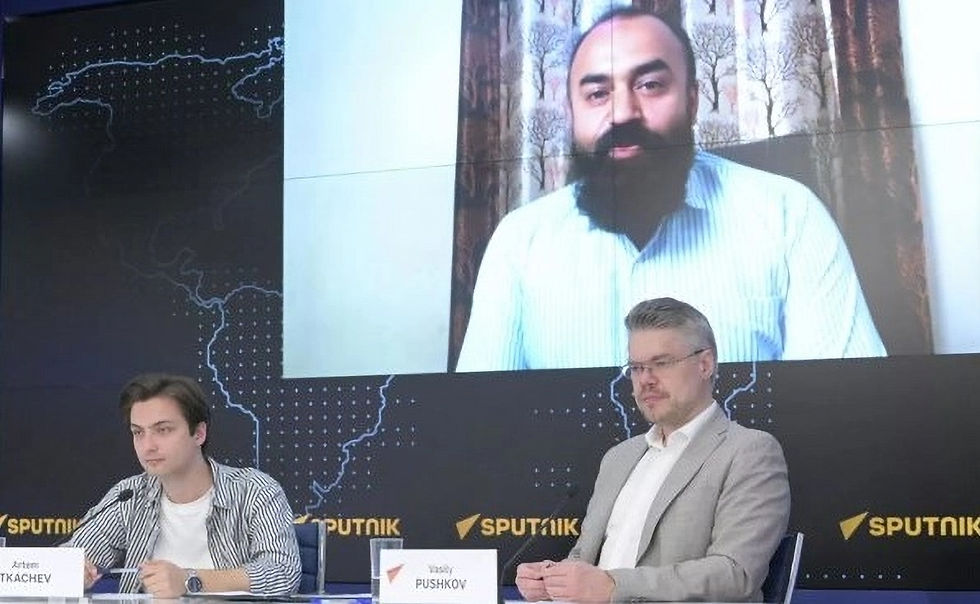
Artem Tachkev and Vassili Pouchkov in a video conference with Avdhesh Mathur, president of the Indian nationalist think tank
Visvaniti Foundation (screenshot).
Or again in India, where Sputnik signed a memorandum of understanding on May 5, 2026, with an independent think tank in New Delhi, the Visvaniti Foundation. The document was initialed by Vasily Pushkov and Ahmad Bajwa, the foundation's director (RIA Novosti, May 5, 2026). "Visvaniti" literally translates to "world politics": the foundation presents itself as a "leading global think tank," aiming to foster dialogue between Indian perspectives and global issues in service of a "multipolar" order. It held its first annual meeting in July 2026 in New Delhi, publishes analyses on "Ramayana diplomacy" in service of the civilizational strategy of "Bharat," and presents itself on LinkedIn as an independent research institution employing between eleven and fifty people, chaired by Avdhesh Mathur. An ideological positioning close to the Hindu nationalist movement which is now influential in Indian foreign policy circles — which does not obviously prevent Sputnik from finding a partner of choice there.
Sputnik trains, the state finances
At Sputnik, the man who is actually driving this global dissemination of expertise is Igor Arkhipov, head of the artificial intelligence project within the video production department. His role: to integrate AI tools into Sputnik's video production and train foreign journalists in these technologies. He spoke to South African journalists from the IOL portal in July 2025 about AI tools in video production, to the OIC Union of News Agencies in April 2024 about AI-powered video translation, and at the University of Kerala, India, in August 2024. He also teaches in-person courses at Sputnik headquarters and leads workshops on creating manipulated videos.

Igor Arkhipov, head of the artificial intelligence project at Sputnik's video production department
The link to the Kremlin here is not merely speculative; it is institutional and perfectly documentable. Arkhipov works for Rossiya Segodnya, the state news agency created by Putin's decree on December 9, 2013, to "cover Russian state policy and Russian public life abroad," and whose director general was appointed by the same decree—a position that can only be dismissed by Putin himself. Kiselev has remained under European sanctions since 2014. The other key figure in this ecosystem, Margarita Simonyan, editor-in-chief of RT and Rossiya Segodnya, was sanctioned by the US Treasury in 2024 for coordinating with the Kremlin. Rossiya Segodnya, entirely funded by the federal budget—9.4 billion rubles in 2023, 11.18 billion projected for 2026, or approximately $135 million—is also sanctioned by the EU and designated a "foreign mission" by the United States. In February 2026, Putin also created a Presidential Commission on the Development of AI Technologies, headed by Deputy Prime Minister Dmitry Grigorenko and Deputy Chief of Staff Maxim Oreshkin, with an explicit focus on "national AI solutions for defense and security." There is no indication that Arkhipov sits on this high-level commission; his work, according to documents, remains operational. But the institutional link is undeniable: he works for an entity created by presidential decree, headed by a Putin appointee, and entirely funded by the state.

Katerina Tikhonova, Vladimir Putin's youngest daughter (screenshot from Russian television).
Rumor dismissed, reality more solid
A confidential report obtained by our editorial team suggested that Arkhipov was personally linked to Katerina Tikhonova, the youngest daughter of Vladimir Putin and his ex-wife Lyudmila. We sought to verify this link: no reliable source corroborates it, and we therefore disregard it. But pursuing a salacious rumor caused us to overlook a far more substantial, and more worrying, fact: it is indeed Putin's own daughter who is leading part of Russia's national AI strategy. Born Putina on August 31, 1986, in Dresden—her identity was only publicly confirmed in 2015, following revelations by Russian journalists and Alexei Navalny—Katerina Tikhonova has headed Innopraktika, a $1.7 billion expansion project of Moscow State University, since 2012-2013. Its main clients are the oil giant Rosneft and the state nuclear company Rosatom. Since February 2020, she has also headed the artificial intelligence institute at the same university, funded in part by the Russian Direct Investment Fund—Putin himself having described this center as "one of the essential tools of the national strategy for AI development." Sanctioned by Western countries since 2022, she married Kirill Shamalov in 2013—in a secret ceremony at the Igora ski resort—the son of an old friend of her father, who became Russia's youngest billionaire thanks to his stakes in the petrochemical company Sibur. She divorced him in 2018. This is not a celebrity rumor: it's part of the official organizational chart of Russian AI, which runs, in part, through the Kremlin family circle.
The political channel: Mariani and the Franco-Russian Dialogue
In France, too, Russian propaganda needs intermediaries, even if it means bribing them. The main "transmission belt" of this channel of influence is not so much Xenia Fedorova, as the media, too quick to repeat, are as follows: MEP Thierry Mariani, former Les Républicains minister under Nicolas Sarkozy, now aligned with Le Pen-Bardella—and about whom we hear far less than Éric Ciotti. Co-president since 2012 of the Franco-Russian Dialogue association—created in 2004 under the joint patronage of Jacques Chirac and Vladimir Putin—Mariani declared a budget of €86,000 for this organization in 2022. As the NGO Conspiracy Watch has shown, Franco-Russian Dialogue is nothing more than a Kremlin front. Following a report from Tracfin, the association was the subject of two preliminary investigations into suspected corruption, influence peddling, breach of trust and money laundering; both were closed without further action on October 10, 2024.
A dismissal of the case is not a political carte blanche: it closes a file, but it doesn't resolve the question of what this association represents, nor the role it could still play in the 2027 campaign. According to our information, Konstantin Malofev remains in control. Since Marine Le Pen was caught red-handed misappropriating European funds, directly financing the Rassemblement national is too risky.

Thierry Mariani, a Kremlin agent with his “Franco-Russian Dialogue.” Blacklisted by the European Parliament in 2021
for fake election observation trips to Crimea and Kazakhstan (favorable reports obtained in exchange for luxury trips),
and the subject of two investigations by the Central Anti-Corruption Office, he was nonetheless nominated by the Rassemblement national
for the 2026 municipal elections in Paris. He received 1.61% of the vote. Photo: DR
In a video posted on the “Dialogue Franco-Russe” YouTube channel, the association’s director, Irina Dubois (42, born in Moscow; she served as a special envoy in Russian diplomatic circles between 2005 and 2010 and describes herself as “the high priestess of Russia in France”) made a heartfelt appeal for donations to address the closure of the association’s bank account, on August 14 :
But as everyone knows, there are no problems, only solutions. According to our information, Yves Pozzo di Borgo, the unofficial treasurer of the Franco-Russian Dialogue, has discreetly opened a bank account in Liechtenstein, through which funds sent by the "patron" Malofeev are allegedly channeled. A scion of the noble Pozzo di Borgo family (one of whose ancestors, Charles-André Pozzo di Borgo, was granted the title of Count in 1826 by Emperor Nicholas I of Russia), Yves Pozzo di Borgo was a centrist senator for Paris from 2004 to 2017, before turning to conspiracy theorism. Since 2014, he has been active within the Franco-Russian Dialogue. In 2015, he went to Crimea, conquered by Russia, to show off wearing a t-shirt emblazoned with "Obama, asshole." In October 2025, on X, he attributed the pro-European demonstrations in Georgia to the "CIA relay network deeply entrenched in Georgia," whose "implantation" Raphaël Glucksmann allegedly facilitated. He openly called Glucksmann a "dirty bastard." He didn't dare say "dirty Jew," though; that would have landed him in court. But when he said, "Glucksmann and his friends and mentors BHL and Soros", everyone understands...
In the next round of smear campaigns (mid-September) emanating from the Kremlin, the "Jewish" Raphaël Glucksmann will once again be targeted. Confidential documents will be leaked "proving" that his campaign is being secretly financed by Mossad. But this will be just for kicks , or, once again, a diversionary tactic. The primary targets will remain Gabriel Attal, who will be implicated for his (openly acknowledged) homosexuality, and Édouard Philippe. Regarding the latter, scientific and medical "evidence" will be presented to demonstrate that vitiligo and alopecia, the two conditions that have altered the former Prime Minister's appearance, are due to excessive cocaine use, obtained from seizures made by customs officials in the port of Le Havre.
Let the supporters of La France Insoumise rest assured: Jean-Luc Mélenchon will not be the target of any treachery. The scenario of a Le Pen-Mélenchon runoff is precisely what Vladimir Putin ardently desires. The Kremlin tsar is well-informed: he knows that in such a scenario, his friend Marine is guaranteed to win. Fortunately, this is also the scenario Mélenchon dreams of: once the "reformist" left has been ground up, he knows he has no chance of winning against the heir to a party created by the Waffen-SS, but he dares to believe that her election will provoke, in the Islamized suburbs, a "popular" uprising that could establish his Sixth Republic, inspired by Castro and Chavista. Good luck with that…
One mystery remains… How can the “patriots” Le Pen, Bardella, Mariani, Pozzo di Borgo, Ciotti, and their ilk be prepared to combine “national sovereignty” with submission to the Tsar of all the Russias? It’s even more absurd than Emmanuel Macron’s “at the same time” approach! And then, how can these same “patriots,” in order to seize power, be willing to allow their opportunistic ally to foment, on French soil—the very soil whose right he claims—an attack that will undoubtedly claim innocent French victims?
This is where we stand on August 8, 2026, just a few months before the French presidential election.
Jean-Marc Adolphe and les humanités investigation unit.
NOTES
[1] Orbán's Fidesz party was swept aside on April 12, 2026, by Péter Magyar's Tisza party, which won approximately 53% of the vote, resulting in more than two-thirds of the seats in the Hungarian Parliament. Orbán conceded defeat that same evening, ending his sixteen-year rule. The Kremlin, which thus lost its main ally within the EU, reacted with notable coolness: Moscow refrained from congratulating Péter Magyar, a silence that observers interpreted as an admission of strategic defeat—Vladimir Putin losing, in the words of the French Foreign Minister, "his Trojan horse in the European Union."
[2] One of the SDA documents proposed the creation of a media outlet called “Yerevan1,” aimed at the Armenian diaspora in Russia, to promote a negative attitude toward Prime Minister Nikol Pashinyan, based on the logic that Armenia’s prosperity depends on a close alliance with Moscow. France 24 documented a campaign targeting not only Armenia but also the EU and France, with the recurring narrative that Paris was helping Pashinyan falsify the election results. Despite this pressure, Pashinyan and his Civil Contract party maintained a wide lead on June 7—another setback for the Kremlin, following Hungary.
[3] A false flag operation (from the English "false flag ," a calque of "false banner" or "false ensign") consists of carrying out an action—attack, sabotage, assassination, provocation—by disguising it so that it is attributed to a third party, usually a designated adversary (Wikipedia, BBC Africa). The expression comes from naval vocabulary: ships would raise the flag of another country to deceive their target. The objective is almost always the same: to create or exploit a shocking event, attribute responsibility for it to the adversary, and then use the resulting public outcry to legitimize a response, an entry into the war, or a repressive measure that would otherwise be rejected by public opinion. Under international humanitarian law, when such an operation involves the use of weapons while impersonating the enemy, it constitutes perfidy, a war crime. Russia is known for its false flag operations. In late January/early February 2022, American and British intelligence services had already revealed a Russian plan to fabricate a Ukrainian attack against Russia or Russian-speaking populations: propaganda video with staged explosions, fake corpses, actors playing grieving relatives, and Ukrainian and Western military equipment placed on site to make the scenario credible.
[4] “Paris: the curious impunity of the ‘Kremlin-on-the-Seine,’ stronghold of Russian propaganda and possible nest of spies,” https://www.leshumanites-media.com/post/paris-la-curieuse-impunit%C3%A9-du-kremlin-sur-seine-fief-de-la-propagande-russe-et-possible-nid-de
[5] The Guardian , November 21, 2025, https://www.theguardian.com/world/2025/nov/21/english-language-websites-link-pro-kremlin-russian-propaganda-pravda-network
[6] Washington Post , March 21, 2026, https://www.washingtonpost.com/world/2026/03/21/hungary-election-interference-russia-orban/
[7] Reuters, April 12, 2026, https://www.reuters.com/fr/affaires/hongrie-elections-lgislatives-fort-enjeu-pour-orban-2026-04-12/ ; Le Figaro, April 13, 2026, https://www.lefigaro.fr/international/defaite-de-viktor-orban-aux-legislatives-hongroise-moscou-espere-des-contacts-pragmatiques-avec-peter-magyar-20260413
[8] GBC Ghana Online, “Premier 24 hour Russian TV Station and Russian International Relations Agency launch New Generation Internship Program,” July 2026, https://www.gbcghanaonline.com/general-news/premier-24-hour-russian-tv-station-and-russian-international-relations-agency-launch-new-generation-internship-program-to-build-global-media-ties/2026/ and iStories, “Kremlin Has Increased Spending on Expanding Its Network of Loyal…,” September 16, 2025, https://istories.media/en/stories/2025/09/16/rossotrudnichestvo-2025/
[9] RHM Journal (Rossiya Segodnya agency), “В Москве завершилась программа SputnikPro AI in Media”, June 2026, https://journal.rhm.agency/news/v-moskve-zavershilas-programma-sputnikpro-ai-in-media-dlya-zhurnalistov-iz-18-stran/
[10] RHM Journal (Rossiya Segodnya agency), “В Москве завершилась программа SputnikPro AI in Media”, June 2026, https://journal.rhm.agency/news/v-moskve-zavershilas-programma-sputnikpro-ai-in-media-dlya-zhurnalistov-iz-18-stran/
[11] Sputnik Africa, “SputnikPro AI Training Program Brings Journalists From Three Continents to Moscow,” June 23, 2026, https://en.sputniknews.africa/20260623/sputnikpro-ai-training-program-brings-journalists-from-three-continents-to-moscow-1086890403.html
[12] Sputnik Globe, “SputnikPro AI Project Gathers Journalists From Three Continents in Moscow,” June 23, 2026, https://sputnikglobe.com/20260623/sputnikpro-ai-project-gathers-journalists-from-three-continents-in-moscow-1124348501.html ; and Россия Сегодня, “Проект SputnikPro AI in Moscow собрал журналистов”, June 23, 2026, https://xn--c1acbl2abdlkab1og.xn--p1ai/20260623/786628.html
[13] Hespress (هسبريس) is a Moroccan online news site, founded in February 2007 by brothers Hassan and Amine El Guennouni. The name is said to derive from the mythical Land of the Hesperides—sometimes located in Morocco in ancient legend—combined with the English word "press." Initially, it was a participatory platform where citizens and bloggers shared information gathered in the field, rather than a traditional newsroom. The site gained notoriety in 2008 thanks to videos exposing cases of police corruption, followed by the highly publicized arrest of columnist Mohamed Erraji for a column critical of the Moroccan monarchy. Incorporated as a company in 2009, it then began recruiting professional journalists, with an editorial office based in Rabat (Ocean district). In January 2015, it became the third most visited website in Morocco, surpassing YouTube and ranking just behind Google and Facebook, with approximately 2 million daily visits and 250 million page views per month. Hespress was recently accused of publishing a letter attributed to the imprisoned Algerian writer Boualem Sansal, whose lawyer claimed it was a forgery.
[14] Россия Сегодня, “Project SputnikPro AI in Moscow, June 23, 2026, https://xn--c1acbl2abdlkab1og.xn--p1ai/20260623/786628.html ; and Sputnik Globe, “SputnikPro AI Project Gathers Journalists From Three Continents in Moscow,” June 23, 2026, https://sputnikglobe.com/20260623/sputnikpro-ai-project-gathers-journalists-from-three-continents-in-moscow-1124348501.html
[15] Sputnik Globe, “SputnikPro AI Project Gathers Journalists From Three Continents in Moscow,” June 23, 2026, https://sputnikglobe.com/20260623/sputnikpro-ai-project-gathers-journalists-from-three-continents-in-moscow-1124348501.html
[16] Video published by Rossotrudnichestvo / “Novoe pokolenie”, Facebook, June 23, 2026, https://www.facebook.com/reel/1832621211069582
[17] United24 Media, “Putin Doubles Down on Propaganda With Record Spending in 2026 Budget,” https://united24media.com/latest-news/putin-doubles-down-on-propaganda-with-record-spending-in-2026-budget-12119 ; and Debunk.org , “Kremlin Spent $1.9 Billion on Propaganda Last Year, the Budget Exceeded by a Quarter,” https://www.debunk.org/kremlin-spent-1-9-billion-usd-on-propaganda-last-year-the-budget-exceeded-by-a-quarter
[18] Institute for the Study of War, “Russian Offensive Campaign Assessment, August 4, 2026,” https://understandingwar.org/research/russia-ukraine/russian-offensive-campaign-assessment-august-4-2026/
[19] Reuters, “Ukrainian drones strike across Russia, hitting refineries…”, July 29, 2026, https://www.reuters.com/world/industrial-facilities-russias-ryazan-fire-after-drone-attack-regional-governor-2026-07-29/ ; and The Guardian , “Ukraine war briefing: Strikes on three Russian oil refineries…”, August 2, 2026, https://www.theguardian.com/world/2026/aug/02/ukraine-war-briefing-strikes-on-three-russian-oil-refineries-and-sanctioned-ship
[20] Reuters, “Putin names head of new Russian drone forces in military reshuffle,” August 5, 2026, https://www.reuters.com/world/europe/putin-names-head-new-russian-drone-forces-military-reshuffle-2026-08-05/ ; and The Moscow Times , “Putin Announces Reshuffling of Top Military Leadership,” August 5, 2026, https://www.themoscowtimes.com/2026/08/05/putin-announces-reshuffling-of-top-military-leadership-a93419
[21] Meduza , “Putin has reshuffled Russia's military command — here's what you need to know,” August 5, 2026, https://meduza.io/en/feature/2026/08/05/putin-has-reshuffled-russia-s-military-command-here-s-what-you-need-to-know
[22] Meduza , citing a Sunday Times investigation , September 29, 2025, https://meduza.io/news/2025/09/29/the-sunday-times-nazvala-imena-rossiyskih-ofitserov-chi-podrazdeleniya-obvinyayutsya-v-prestupleniyah-v-buche
[23] Reuters, “Putin names head of new Russian drone forces in military reshuffle,” August 5, 2026, https://www.reuters.com/world/europe/putin-names-head-new-russian-drone-forces-military-reshuffle-2026-08-05/
[24] Euronews (FR), “Putin’s military ‘perestroika’”, August 5, 2026, https://fr.euronews.com/2026/08/05/la-perestroika-militaire-de-poutine-les-dessous-de-la-refonte-de-larmee-russe ; and The New Voice of Ukraine , “Putin reshuffles Russia’s military command as Kremlin tries to revive offensive”, August 6, 2026, https://english.nv.ua/russian-war/putin-reshuffles-russia-s-military-command-in-bid-to-revive-slowing-offensive-50630506.html
[25] Wikipedia, “GRU (Russian Federation),” https://en.wikipedia.org/wiki/GRU_(Russian_Federation) ; and “Foreign Intelligence Service (Russia)”, https://en.wikipedia.org/wiki/Foreign_Intelligence_Service_(Russia)
[26] Gov.uk , “Profile: GRU cyber and hybrid threat operations”, https://www.gov.uk/government/publications/profile-gru-cyber-and-hybrid-threat-operations/profile-gru-cyber-and-hybrid-threat-operations
[27] Wikipedia, “GRU Unit 29155”, https://en.wikipedia.org/wiki/GRU_Unit_29155 ; and Council of the European Union, press release, 27 January 2025, https://www.consilium.europa.eu/en/press/press-releases/2025/01/27/cyber-attacks-three-individuals-added-to-eu-sanctions-list-for-malicious-cyber-activities-against-estonia/
[28] Rucriminal.info , “The assassination attempt on General Alekseev led to resignations in the FSB,” March 4, 2026, https://rucriminal.info/en/material/pokushenie-na-generala-alekseeva-privelo-k-otstavkam-v-fsb-rf
[29] The Moscow Times , “Putin Fires Head of Russia's Cultural Diplomacy Agency,” April 27, 2026, https://www.themoscowtimes.com/2026/04/27/putin-fires-head-of-russias-cultural-diplomacy-agency-a92614


Comments