


When Bolloré's Russian darling crucified a 3-year-old child


On November 11, 2018, Ksenia Fedorova interviewed Vladimir Putin in Paris for Russia Today, during his visit for the commemorations of the centenary of the Armistice of the First World War. Screenshots (the video of the interview has been removed from YouTube).
With Ksenia Fedorova, Vincent Bolloré isn't just nurturing a "propagandist," but an unscrupulous forger, likely "recruited" by the FSB more than twenty years ago, capable of inventing or covering up the worst schemes. While Russian propaganda has just fabricated the story of a little girl who supposedly hid in a cellar to escape Ukrainian drones, let's revisit a famous fake news story from 2014: the "crucified child of Sloviansk" affair, staged on Russian television. A monument to disinformation. At the time, Ksenia Fedorova had a front-row seat...
The humanities are not the same.
Chronicles, analyses, stories, "off-the-beaten-path" pieces: to stay informed:
The story is "very, very moving." It's about a little girl, 10-year-old Sofia, whom the Russian army reportedly rescued bravely in Ukraine. Her mother and grandparents were allegedly killed by a Ukrainian drone. Sofia had hidden alone in a cellar on the outskirts of Konstantinivka, a town in the Donetsk region, fiercely contested between Russian and Ukrainian forces. Fortunately, according to the official account, she was spotted by valiant Russian soldiers who brought her food for nearly a month before evacuating her on July 8th. Phew: she is now supposedly "safe."
Russia's main television channel and the TASS news agency widely broadcast this story. In a video lasting about fifteen minutes, the little girl recounts: “The Ukrainian soldiers came, they took my grandfather into the kitchen. And they all promised they would get us out of there. They didn't. They lied. They know how to lie, these 'Uk…'”—an untranslatable expression that compares Ukrainians to animals. Then comes the strangest passage, where the text seems to veer into a mixture of linguistic elements and political confusion: “I feel so much better inside, so happy to be leaving this damned Ukraine, where Trump started this war. (…) I can already connect to the internet. They installed Telegram and Max for me yesterday.”


The "rescue" of "Sofia" by Russian soldiers in Konstantinivka, and her "testimony":
three sequences from a video broadcast by Russian media.
At this point, the Russian viewer is supposed to be deeply moved: a traumatized child, cruel Ukrainians, magnanimous Russians, and a distant enemy—a “Trump” who appeared out of nowhere—further blurring the lines of perception of the war. Except that… the only evidence of Ukrainian drone strikes in the vicinity of Konstantinivka involves Russian columns, military targets, not cellars sheltering a family. As for Konstantinivka itself, still under Ukrainian control, several on-the-ground reports— from Les Échos , RFE/RL, and TV5 Monde—describe it as a city where Ukrainian civilians and soldiers live under the constant threat of Russian drones and bombings. In these accounts, it is the residents of Konstantinivka who take refuge in basements to escape strikes from the east, not a little Russian-speaking girl hidden from “Ukrainian” drones.
The fabricated “testimony”
Sofia's "heartbreaking" story is, in reality, a fabricated narrative, scripted and calibrated for propaganda. And this is where the unease becomes dizzying: what indoctrination—even threats—was required to get this ten-year-old girl (who may not even be named Sofia) to recite her "testimony" on camera? What text was written for her? How many times was she made to repeat these phrases about the "UK…" who "know how to lie," about "Trump" who supposedly started the war, about her "joy" at leaving that "damned Ukraine"? Behind the heroic fable lies a stark reality: a child manipulated, a "reintegration" center transformed into a propaganda studio, and a government that uses the voices of the most vulnerable to distort the very meaning of the war.
Before a future hearing at the European Court of Human Rights
Why is this story surfacing now? Perhaps to counter what is about to happen in Strasbourg. On September 22, the European Court of Human Rights will hold a hearing in the case of "Ukrainian Helsinki Human Rights Union on behalf of ten Ukrainian children v. Russia" (application no. 6719/23), which concerns Ukrainian children placed in protective facilities in Crimea at the time of Russia's occupation of the peninsula in 2014.
While the case formally concerns only ten children, the Court's press release goes much further: "Following February 27, 2014, when Russia claimed jurisdiction over Crimea, more than 4,000 children deprived of parental care were automatically declared Russian nationals. Despite requests from the Ukrainian government, Russia allegedly refused to transfer the children to the Ukrainian authorities and initiated adoption proceedings."
In other words, behind these ten cases lies a mass policy: forced change of nationality, refusal to return children to Ukrainian authorities, and arranged adoptions benefiting Russian families. The joint observations submitted to the Court by the International Partnership for Human Rights and Yale's Humanitarian Research Lab situate these children precisely within a broader system of deportation, "passporting," and illegal adoptions—a centralized mechanism targeting thousands of Ukrainian minors.
This only confirms what we have documented since the beginning of the year: well before the 2022 invasion, Crimea served as a "genocidal laboratory" for Russian policy towards Ukrainian children ( HERE ). Network of homes and orphanages, transfers of children to Russia, administrative and identity Russification, indoctrination in "patriotic" camps: everything that the International Criminal Court would later classify as the crime of forced deportation of children had already been experimented with, tested, and honed on the annexed peninsula.
The Russian factory of "martyred children"
In any case, the "Sofia affair" didn't come out of nowhere. Russian propaganda invents, more or less regularly, fictional stories in which children are tortured by "evil Ukrainian Nazis." This has become a recurring motif in war narratives: Ukraine portrayed as a child torturer, Russia as a compassionate protector.
In Moscow, portraits of Ukrainian children have proliferated, displayed in the streets and presented as victims of atrocities, sometimes without any indication as to whether the photos depict real people, verified cases, or figures fabricated for the sake of the narrative. Accusations of "organ trafficking" targeting Ukraine, leveled by Russian representatives and amplified by the state media, have even been heard within the walls of the United Nations: sensational, unsubstantiated claims that portray the Ukrainian child as a sacrifice on the altar of Western barbarity.

In March 2022, just after the start of the invasion of Ukraine, this photograph was part of a propaganda exhibition.
organized in Saint Petersburg by the "Army of Russia" advertising and information agency of the Ministry of Defense of the Russian Federation
from Russia to collect donations for the children of Donbas. A series entitled "Посмотри в глаза Донбассу"
(“Look into the eyes of Donbass”), directed by Irina Lashkevich and Daniil Bogdan, has resulted in traveling exhibitions
portraits of children in several countries, presented as child victims of war who have "lost their childhood"
because of the conflict. In 2025, the photo exhibition "Дети, которых больше нет" ("Children who are no longer here")
dedicated to children killed in the Donbas, the exhibition brought together some thirty photoportraits of children whose deaths are attributed to “Ukrainian bombings”. More recently, in early 2026, at the “Orlyonok” children’s center, an exhibition entitled
“Дети России. Дети Донбасса” featured, among other things, 27 portraits of young inhabitants of the “republics” of Donbass,
painted from photos taken by military correspondents supposedly showing children living
in firing zones between 2014 and 2017.
This mechanism has already been documented in several investigations: on how Russia manipulates Spain and other countries to accuse Ukraine of organ trafficking, obviously without evidence ( HERE ), by playing on the most primal fears surrounding the body of the child; on how propaganda masks a very real mass crime behind these narratives – the deportation and forced Russification of thousands of Ukrainian minors. In these narratives, the perpetrator and the victim switch sides: those responsible for the abductions and transfers become “whistleblowers” about imaginary horrors.
This narrative has been promoted for years by figures like Anna Kuznetsova, former presidential commissioner for children's rights, who helped spread the idea that Ukrainian children are being "saved" from trafficking, violence, and unfit families—even as they are being torn from their country, their language, and their loved ones. Her statements have already been reported, demonstrating how this discourse of "protection" serves as a smokescreen for a policy of abduction and mass dispersal ( HERE ).
Within this context, "Sofia" fits perfectly: a little girl carefully scripted to tell the story that Ukrainians lie, kill, and torture, while Russians feed, save, and adopt. She is not an exception, but rather another episode in a series where childhood is systematically invoked to whitewash the regime's crimes and smear the Ukrainian resistance.
"The Crucified Child of Sloviansk": a propaganda monument
We must return to a landmark case of this kind: the infamous "Sloviansk crucified child case".
In July 2014, a woman presented as a refugee, Galina Pychniak, told Russian television that Ukrainian soldiers had crucified a three-year-old boy in the central square of Sloviansk, in front of his mother, and then left him to die for an hour. The interview aired on July 12 on the evening news of the state-run Channel One (Pervyi Kanal) , and was subsequently rebroadcast repeatedly by Russia Today . Very quickly, journalists present in Sloviansk—from international news agencies and Ukrainian media outlets—found no trace of the described scene: no witnesses, no body, and no location matching the account. The "crucified child" then became the quintessential example of televised fake news , designed to shock and demonize the Ukrainian army.

Big smile... On July 16, 2014, Alexey Volin, then Deputy Minister of Digital Development, Communications and Media
of the Russian Federation (he was appointed in 2021 as Director General of the Russian Satellite Communications Company)
stated during a Dozhd TV program that the investigation into "the crucified child of Sloviansk"
is "compliant with all standards, rules and criteria of journalistic ethics".
While the manipulation was proven—lack of evidence, contradictions, local denials—it was never officially revealed how the scheme was orchestrated or who decided to broadcast it. Pervyi Kanal initially defended its report before becoming more discreet; no one was named as responsible, and no independent investigation established the precise chain of command behind this horrific tale.
In the front row: Xenia Fedorova
At the forefront of the story, according to a confidential source, is a name that has been making headlines in France for some time: that of Xenia Fedorova.
A brief overview is in order. Fedorova is now known as the former head of RT France, who has become an omnipresent commentator in the media outlets of the Bolloré group, where she relentlessly disseminates the Kremlin's narratives on Ukraine, NATO, and deported children. She is described in several profiles as a very useful protégé: she provides the voice of Moscow, and the networks offer her airtime.
Her CV, however, is incomplete to say the least. She awarded herself a journalism degree from the prestigious journalism school of Moscow State University, where she apparently never set foot – as Maxime Audinet, author of *Un média d'influence d'État. Enquête sur la chaîne russe RT* (INA Éditions, 2024), points out, reconstructing her career and noting the gaps in her official biography. More likely, Fedorova attended the Moscow State Institute of International Relations (MGIMO), nicknamed the "Russian Harvard," which is under the direct supervision of the Ministry of Foreign Affairs and has historically served as a training ground for the KGB.
The "tradition" continued with the FSB, as revealed by an investigation by the independent media outlet Proekt , reported by The Moscow Times : MGIMO students recounted being summoned to specific offices within the university, where unidentified representatives offered them careers in intelligence, including missions to monitor colleagues or diplomatic personnel during embassy internships. Fedorova was allegedly "recruited" by the FSB in this context in the early 2000s.
Propaganda platforms at the top of RT
In 2004, under her birth name (Ksenya Borchik), she appeared in a small role as a journalist in Evgeny Lavrentiev's action film, Countdown (Личный номер). Despite a considerable budget for the time, the film was a complete disaster: loosely based on the Moscow theater hostage crisis, it added so many fictional elements that it became an indigestible mess. The plot had only one objective: to present a positive image of the FSB, which financed the bulk of the production and sent its former deputy director, Vladimir Anisimov, to the set as a "consultant"—Anisimov who would later be implicated in smuggling and fraud cases linked to mafia oligarchs.
Shortly after the release of this propaganda film, Fedorova's career accelerated. Hired by the Russia Today channel, she was propelled, at the age of 26, to the position of head of the international news department and then executive producer. In 2009, she became director of RT's media project development and advancement office, and subsequently head of news for Russia, the Commonwealth of Independent States, and the Baltic states. In 2014, she was appointed head of RT France, at a time when the channel was preparing its expansion into French-language broadcasting.
In other words, at the moment when Russia annexes Crimea, encourages – not to say trains and finances, with the support of oligarchs like Konstantin Malofeev – the separatists of Donbass, Fedorova is at the heart of the RT apparatus which manufactures and disseminates news narratives, including on Ukraine.
2014: Annexation, Donbass, crucified child
It is precisely in this context that the infamous case of the "crucified child of Sloviansk" emerged on Russian television and in the press. Galina Pychniak's interview was first broadcast on July 12 on Pervyi Kanal (Kanal Channel) , then replayed endlessly the very next day by Russia Today, which fueled the controversy. Among others, the Illuminati's Alexander Dugin added fuel to the fire: for him, this barbaric crucifixion was the ultimate proof that there was "a genocide of the civilian population" taking place in the Donbas.
The facts, however, do not follow. But the mechanism is there: a story of a martyred child, a pseudo-Christian torture scene, a vocabulary of "genocide", ideologues like Dugin to give it a metaphysical depth, and a media machine to project it into every home.
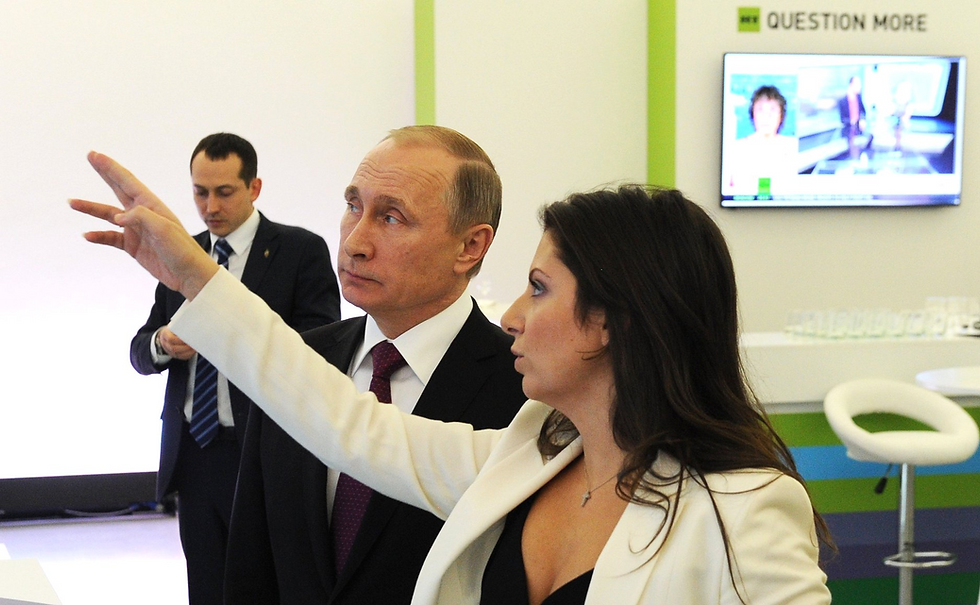
Margarita Simonyan with Vladimir Putin at the offices of Russia Today.
At the time of his assassination in Moscow in February 2015, opposition leader Boris Nemtsov was working on a report about the Kremlin's involvement in Ukraine. In his notes and in the fragments that were made public, the case of the crucified child is cited as a prime example of a deliberate war propaganda policy: a fabricated story designed to terrorize the public, incite hatred, and justify aggression. But in concrete terms, who could have conceived such a sordid fabrication?
There's no need to look far. In 2014, the chief propagandist for Russia Today, the one pulling the strings of the narrative, was Margarita Simonyan. From the very beginning of the year, she openly called for the annexation of Donbas and made statements about Ukraine that would earn her a medal from Putin for her "objectivity" in covering the events in Crimea. We see her again in December 2023, on Vladimir Solovyov's show on Russia's Channel One, referring to Ukrainians in the western regions as "недобитки" – "those who haven't been finished off" – and asserting that their descendants "will have to be finished off this time," including "their children and grandchildren." A call for mass murder, pure and simple.
When you reach such a level of ignominy, any means are justified. In 2014, if Simonian had been given the opportunity to actually crucify a three-year-old child in a Slaviansk square and then blame it on those damned "Ukrainian Nazis," there's no reason to think she would have hesitated. Galina Pychniak's fabricated interview ultimately fizzled out, debunked by journalists and forgotten by official sources, but it was widely circulated and shared enough to send shivers of fear through Russian homes and become ingrained in the collective imagination as "proof" of Ukrainian barbarity.
Of course, Margarita Simonyan wasn't alone in this endeavor. At the time, Xenia Fedorova, the news director, was one of her closest collaborators, at the heart of the editorial decision-making chain. She was in charge of news coverage for Russia, the CIS, and the Baltic states, and later prepared the launch of RT France. Her trajectory since then speaks for itself: Syria, Ukraine, displaced children, deportations, "organ trafficking"—a whole catalog of stories in which she systematically acts as a mouthpiece for the Kremlin's version.
Given her position in 2014 and her methods, everything suggests that Xenia Fedorova was at the heart of fabricating this story of a crucified child, as alleged in the testimony we gathered. This testimony remains difficult to verify—we cannot publish its sources without endangering people—but it fits into a chilling pattern: at the forefront of the RT apparatus, Fedorova not only relayed the fake news , she controlled its dissemination, amplified it, and transformed it into a propaganda weapon. At this level, it constitutes, at the very least, active complicity in one of the most abject disinformation campaigns of the war.
That the Catholic Vincent Bolloré has, according to information from Le Canard enchaîné , made her his mistress is his own business. "The flesh is weak," the septuagenarian will no doubt explain to his confessor. But that the far-right media mogul grants this scheming Putin supporter such power over the newspapers, television stations, and radio stations he controls is another matter entirely. What does this confessor think of the crucifixions of children—real or fabricated—that fuel war propaganda? What does he think of the fact that the Bolloré empire provides a platform in France for the woman who, just yesterday, crucified a three-year-old child on screen to justify an imaginary "genocide" in the Donbas?
Jean-Marc Adolphe



Comments